21-day free trial — no credit card required

Your Collections,
Always Fresh

Automatically sort Shopify collections by availability, price, and vendor mix. Stop losing sales to buried products — and stop wasting hours doing it manually.

21 days free on any paid plan — cancel anytime, no questions asked.

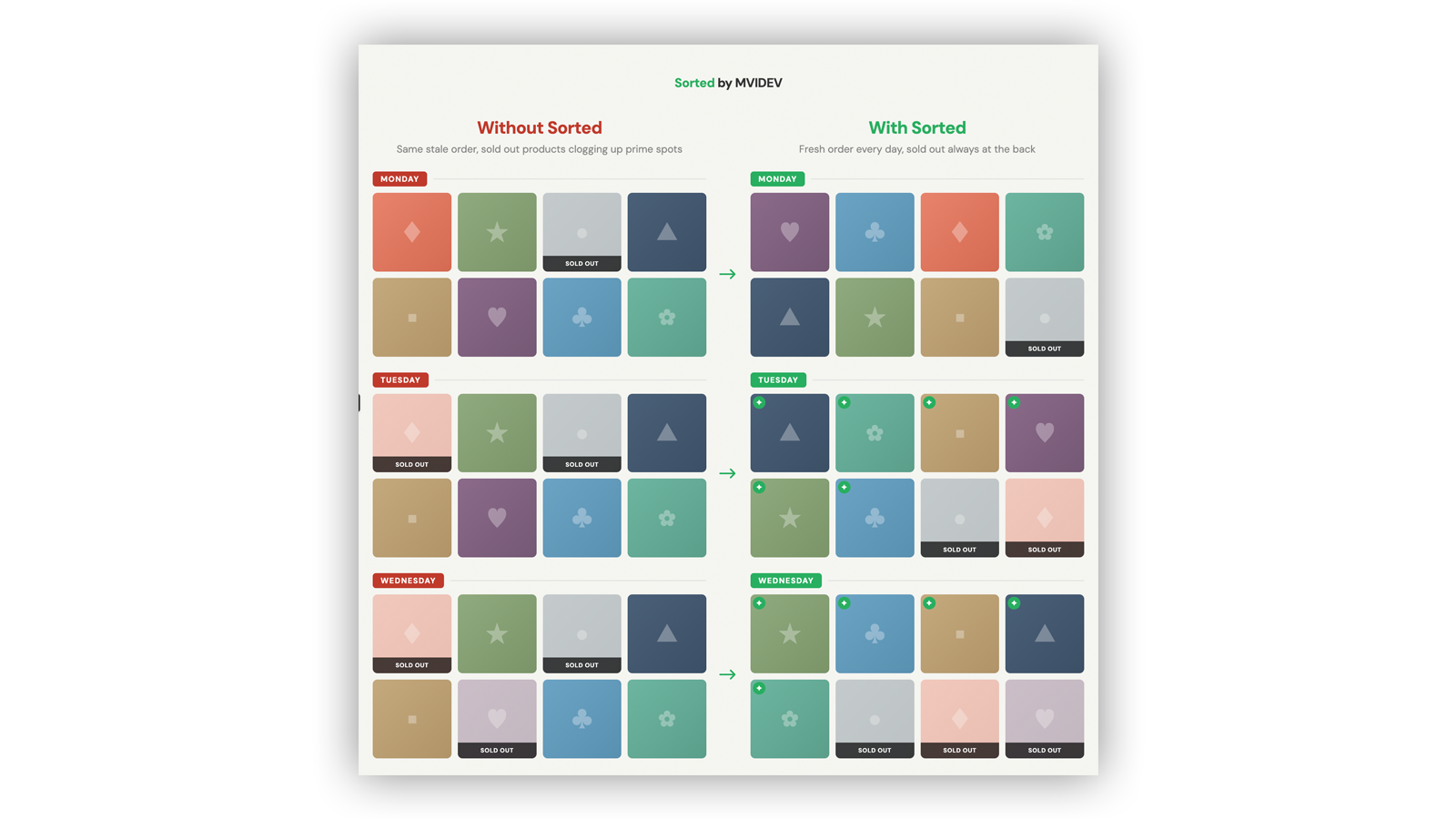
Before and after comparison — Without Sorted vs With Sorted

The Hidden Cost of
Stale Collections

Every day your collections stay unsorted, you're losing sales. Here's what's happening behind the scenes in stores that don't automate their merchandising.

Out-of-Stock Products on Top

Sold-out items sit at the top of your collections, greeting customers with disappointment. They bounce before ever seeing what you actually have to offer.

New Arrivals Get Buried

Fresh products land at the bottom of your collections. The items you're most excited about — the ones that drive repeat visits — never get seen.

Vendor Monotony

The same brand dominates the first page of your collections. Customers assume you only carry one vendor and miss the diversity of your catalog.

Hours Lost to Manual Sorting

You're dragging and dropping products one by one, across dozens of collections, every single week. That's time you'll never get back.

Every Sorting Strategy
You'll Ever Need

From simple alphabetical sorts to intelligent availability-aware vendor mixing, Sorted! gives you complete control over how your collections are organized.

Availability Sort

In-stock products automatically rise to the top. Out-of-stock items sink to the bottom where they won't frustrate shoppers.

Vendor Mixing

Interleave products from different brands in configurable chunks. Give every vendor fair representation and keep pages dynamic.

Auto-Sort Scheduling

Set it and forget it. Your collections are re-sorted daily — automatically — keeping everything fresh without any manual intervention.

Price & Alpha Sorting

Sort by price (low to high or high to low) or alphabetically. Classic sorting strategies that just work, instantly applied to any collection.

Smart Rate Limiting

Built-in protection against API overuse. Sorted! intelligently throttles operations to keep your store safe and Shopify happy.

Bulk Operations

Sort up to 10 collections simultaneously. Select your collections, choose a strategy, and let Sorted! handle them all in one go.

Up and Running
in Three Steps

01

Install & Connect

Install Sorted! from the Shopify App Store. It connects instantly to your store — no configuration needed, no code changes required.

02

Choose Your Strategy

Select the collections you want to sort and pick your strategy: availability, vendor mixing, price, alphabetical — or combine them for maximum impact.

03

Enable Auto-Sort

Turn on daily automatic sorting and let Sorted! handle the rest. Your collections stay fresh, optimized, and conversion-ready — every single day.

21
days
free

See what your store looks like
when it runs itself.

We could tell you that merchants save 10+ hours a week. We could tell you that fresh collections convert better. But honestly? We'd rather you just try it. Three weeks is enough time to feel the difference — your mornings freed up, your collections always current, your store working while you sleep. All at absolutely zero cost.

Full access to every feature on your chosen plan
No credit card required to start
Cancel in one click before your trial ends — you'll never be charged
Keep everything you sorted during the trial, forever

Deep Dives for
Serious Merchants

Learn why automated collection management is the competitive edge your store needs.

There is a moment, roughly two to three seconds long, that determines whether a visitor to your Shopify store becomes a customer or another bounce statistic. It happens the instant they land on a collection page and their eyes scan the first row of products. In that narrow window, a shopper makes a subconscious judgment: "Is this store for me? Do they have what I want?" If the answer feels like no — because the products they see are irrelevant, out of stock, or uninspiring — they leave. And they almost never come back.

The Psychology of the First Scroll

E-commerce research has consistently shown that the vast majority of purchase decisions are influenced by the first eight to twelve products a customer encounters in a collection. This isn't about having fewer products — stores with deep catalogs actually convert better, provided they surface the right items first. The critical factor is positioning: which products appear above the fold and in what order.

Think about how you browse a physical retail store. The window display draws you in. The front tables showcase seasonal highlights and bestsellers. The clearance rack is in the back corner, not the entrance. Every brick-and-mortar retailer understands this instinctively. Yet online, most Shopify stores leave their digital "window display" completely unmanaged — products appear in whatever default order Shopify assigned, and they stay that way until someone manually intervenes.

Why Manual Sorting Doesn't Scale

For a store with ten products in three collections, manual sorting is trivial. But the reality of modern e-commerce is far more complex. A mid-size fashion retailer might carry five hundred products spread across forty collections. A home goods store might have two thousand products across sixty collections. At that scale, manual sorting becomes a full-time job — and one that's never actually finished, because inventory changes daily.

Every time a product sells out, it should move down. Every time new stock arrives, those items should move up. Every time a new product is added to the catalog, it needs to be properly positioned in every relevant collection. Multiply that by dozens of collections, factor in seasonal rotations and vendor relationships, and you have a merchandising nightmare that no human can keep up with consistently.

The Conversion Impact of Stale Collections

When collections aren't actively managed, several damaging patterns emerge. The most obvious is out-of-stock visibility — products that can't be purchased sitting prominently at the top of a collection. This doesn't just create a poor user experience; it actively signals to customers that your store isn't well-maintained. Shoppers interpret out-of-stock items at the top of a page the same way they interpret a dusty display in a physical store: this business isn't paying attention.

The second pattern is new arrival burial. When you add a fresh product to an existing collection, it often lands at the bottom — far below the scroll depth of most visitors. Your newest, most exciting products become invisible to the majority of your traffic. You invested in sourcing that product, photographing it, writing the description, and setting up the listing. If nobody sees it because it's buried on page three of a collection, that entire investment is wasted.

The Competitive Advantage of Intelligent Sorting

Stores that automate their collection sorting gain an advantage that compounds over time. Their collections are always current, always showing available products first, always surfacing new arrivals in prominent positions. This freshness drives repeat visits — customers learn that every time they check back, there's something new to discover. It builds a perception of a vibrant, active store that's constantly updating its offerings.

Intelligent sorting also enables more sophisticated merchandising strategies. Vendor mixing, for example, ensures that a single brand doesn't dominate the top of a collection — instead, products from different vendors are interleaved, giving customers a sense of variety and curation. This is the kind of nuanced merchandising that luxury department stores spend millions on. With the right tools, any Shopify merchant can achieve the same effect automatically.

The bottom line is straightforward: product positioning is not a cosmetic concern. It's a fundamental driver of conversion, average order value, and customer lifetime value. Stores that treat their collection order as an afterthought are leaving money on the table every single day. The good news is that solving this problem has never been easier — automation handles the heavy lifting, and the results speak for themselves.

Not all collection sorting strategies are created equal, and the best approach for your store depends on your catalog size, industry, vendor relationships, and customer behavior. This guide breaks down every major sorting strategy, explains when each one shines, and helps you build a sorting plan that matches how your customers actually shop.

Availability Sorting: The Foundation

If you implement only one sorting strategy across your entire store, it should be availability sorting. The logic is simple but powerful: products that are in stock rise to the top, products that are out of stock but set to "continue selling" sit in the middle, and products that are completely unavailable sink to the bottom.

This approach solves the single most damaging merchandising problem in e-commerce — showing customers products they can't buy. Every out-of-stock item at the top of a collection is a micro-frustration that erodes trust. With availability sorting running daily, your collections self-correct overnight. A product sells out during the day, and by tomorrow morning it has been repositioned so that available products take its place.

Availability sorting is particularly valuable for stores with high inventory turnover. A sneaker retailer, for instance, might have sizes going in and out of stock hourly. A beauty supply store might carry products from brands that frequently go on backorder. In both cases, the collection order needs to reflect reality — and that reality changes constantly.

Vendor Mixing: Curated Variety

Vendor mixing is a strategy borrowed from physical retail merchandising, where store managers carefully arrange products so that no single brand dominates any shelf or display. In a Shopify collection, vendor mixing interleaves products from different brands in configurable chunks — for example, two products from Brand A, then two from Brand B, then two from Brand C, and so on.

Consider a fashion boutique that carries fifty different designers. Without vendor mixing, the default sort might put twenty dresses from the same designer at the top of the "New Arrivals" collection. To a customer, this looks monotonous — as if the store only carries one brand. With vendor mixing enabled, those fifty designers are each represented in the first few rows. The customer immediately understands the breadth of the catalog, which encourages deeper browsing and higher engagement.

Vendor mixing becomes even more powerful when combined with randomized brand order. Instead of always showing the same vendor first, the app shuffles the starting order each time it sorts. This means that every day, a different set of brands leads the collection. For multi-brand retailers, this is a fairness mechanism — no single vendor gets permanently promoted over others — and for customers, it creates a sense of novelty with every visit.

Price Sorting: Strategic Positioning

Price-based sorting is straightforward in concept but strategic in application. Sorting by price ascending (lowest first) works well for discount and value-focused collections, clearance sections, and stores where price sensitivity is high. Customers shopping for deals want to see the most affordable options immediately.

Sorting by price descending (highest first) is a common strategy for luxury and premium collections. Leading with your most expensive products establishes the quality tier of the collection and creates a psychological anchor that makes mid-range products feel more accessible by comparison. This is a well-documented pricing psychology technique used by high-end retailers both online and offline.

Mixed Availability: The Advanced Play

Mixed availability sorting takes the basic availability concept further by specifically interleaving in-stock products with "continue selling" products (items that are technically out of stock but can still be purchased because they're made to order, can be backordered, or are pre-sale items). This prevents all your "continue selling" products from being grouped together in a block — instead, they're woven between in-stock items, giving them better visibility while still ensuring truly unavailable products remain at the bottom.

This strategy is ideal for stores that rely heavily on pre-orders, made-to-order items, or drop shipping arrangements where "continue selling" products are a significant portion of the catalog.

Building Your Strategy Stack

The most effective approach for most high-volume stores is to combine strategies based on collection type. Your main catalog collections might use availability sorting with vendor mixing to maximize variety and in-stock visibility. Your "New Arrivals" collection might use creation date sorting to keep the freshest products on top. Your "Sale" collection might use price ascending so deal-seekers find the biggest discounts first.

The key insight is that different collections serve different purposes, and the sort order should reinforce that purpose. With automated daily sorting, maintaining multiple strategies across dozens of collections costs you nothing — the system handles it all while you focus on sourcing, marketing, and growing your business.

If you run a Shopify store with more than a hundred products, you already know the feeling. It's Monday morning, and before you can work on marketing campaigns, answer customer emails, or plan your next product launch, there's a nagging task in the back of your mind: the collections need to be re-sorted. Products sold out over the weekend. A new shipment arrived Friday afternoon. The "Spring Collection" still has winter holdovers sitting in the top positions. So you open the Shopify admin, navigate to the first collection, and start dragging products around. And then you do it again for the next collection. And the next one.

The Real Cost of Manual Merchandising

Most store owners dramatically underestimate how much time they spend on collection management. They think of it as a five-minute task because they're only thinking about one collection at a time. But add up the minutes across a full week — checking inventory, identifying which products need to move, actually performing the drag-and-drop reordering, verifying the results across ten, twenty, or fifty collections — and the total is staggering.

For a store with thirty collections and three hundred products, a thorough weekly sort typically takes eight to twelve hours. That's not an exaggeration — it includes the time spent opening each collection, scrolling through products, checking stock levels, making sorting decisions, executing the changes, and occasionally making mistakes that need to be fixed. For stores with larger catalogs, the number climbs even higher.

But the time cost is only part of the story. There's also the opportunity cost. Every hour spent on manual sorting is an hour not spent on activities that drive growth — creating content, running ad campaigns, building vendor relationships, improving product photography, or engaging with customers. These are the activities that compound over time and differentiate successful stores from stagnant ones.

How Auto-Sort Changes the Equation

Automated collection sorting fundamentally changes this dynamic. Instead of a recurring manual task that demands attention every few days, collection management becomes a configure-once operation. You choose your sorting strategy for each collection — availability sort for your main catalog, vendor mixing for multi-brand collections, price sorting for your sale section — and the system handles execution on a daily schedule.

Every night, while you sleep, the automation runs through your collections. It checks the current inventory status of every product, applies your chosen sorting strategy, and reorders the products accordingly. By the time you open your laptop in the morning, your entire storefront has been freshly merchandised. Products that sold out yesterday have been pushed down. New arrivals have been positioned according to your strategy. Vendors are properly mixed and rotated.

This isn't a marginal improvement — it's a complete elimination of the manual sorting workflow. The ten-plus hours per week that were previously devoted to collection management are now available for higher-value work. Over the course of a year, that's more than five hundred hours reclaimed.

The Before and After

Consider a concrete scenario. A mid-size home decor store carries four hundred products from twenty-five vendors across thirty-five collections. Before automation, the store owner or a team member spent roughly two hours every weekday on collection sorting — opening each collection, checking stock, dragging products, ensuring nothing looked off. That's ten hours per week, forty hours per month, and despite that effort, collections were still stale for much of the day because sorts only happened when someone had time.

After enabling automated daily sorting with availability and vendor mixing, that same store's collections are updated every night. The ten hours per week of manual sorting dropped to less than thirty minutes of occasional strategy review. The store owner redirected that time toward Instagram content creation and email marketing, which directly contributed to a noticeable increase in engagement and returning customer visits.

Why Daily Sorting Matters

Some store owners wonder whether weekly sorting would be sufficient. The answer, for any store with meaningful inventory turnover, is no. Inventory changes daily — sometimes hourly. A product that was in stock this morning might sell out by afternoon. A restocked item might arrive in the warehouse at midday. If your collections are only sorted once a week, they're stale six out of seven days.

Daily sorting ensures that every morning, your storefront reflects the current state of your inventory. Customers who visit your store on Tuesday see a different, fresher arrangement than what they saw on Monday. This freshness is a subtle but powerful driver of repeat visits. Returning customers who see the same static arrangement every time learn that there's no reason to come back frequently. Returning customers who see a fresh, dynamic layout every time learn to check in often — and frequent visitors are your most valuable customers.

The ROI Calculation

The math is compelling regardless of store size. If you value your time at even a modest rate, the ten-plus hours per week of manual sorting represents a significant expense. Replace that with automated sorting, and the return on investment is immediate and ongoing. But the real ROI extends beyond time savings — it includes the conversion improvements from always-optimized collections, the customer retention benefits of a consistently fresh storefront, and the compounding value of redirecting those reclaimed hours toward growth activities.

The best merchandising in e-commerce happens when it's automated, consistent, and running every single day without fail. Human attention is too valuable and too inconsistent to waste on a task that a well-designed system handles better. Set your sorting strategies, enable auto-sort, and redirect your energy toward the work that only you can do — building the brand, connecting with customers, and growing the business.

Try Any Plan Free
for 21 Days

Pick the plan that fits your catalog size. Every paid plan comes with a full 21-day free trial — no credit card, no commitment. If you don't save time and see results, cancel before the trial ends and you won't pay a cent.

No credit card required  ·  Cancel anytime  ·  Full features unlocked from day one
Free
For small stores getting started with smart sorting.
  • Up to 50 products
  • Availability sorting
  • Manual bulk sorting
  • Vendor mixing
  • Auto-sort scheduling
21-day free trial
Sort 100
All features unlocked for growing stores.
  • Up to 100 products
  • All sorting strategies
  • Vendor mixing
  • Auto-sort scheduling
  • Bulk operations

No credit card required

21-day free trial
Sort 1000+
Unlimited power for high-volume operations.
  • Unlimited products
  • All sorting strategies
  • Vendor mixing
  • Auto-sort scheduling
  • Bulk operations

No credit card required

21 Days to Reclaim
Your Time.

Install Sorted! and let the next three weeks speak for themselves. Your collections will sort themselves every night. You'll stop thinking about merchandising and start thinking about growth.

If you don't love it — if you don't feel the time savings, if your collections don't look sharper — cancel before day 21 and pay nothing. Not a cent. We're that confident.

No credit card  ·  Cancel anytime  ·  Full features from day one